
Everything goes grey



POV piece responding to "The Great Flattening, Part 2: The Data Is Worse Than the Anecdotes" (State of Brand, May 25, 2026).
Everything goes grey
The State of Brand argues that AI-generated text is structurally converging: 81% similarity between models built on opposite sides of the planet. For many of us, that feels spot on.
An identical dynamic is playing out in visuals. The same soft lighting on everything. The same so-called product hero. AI gloss across completely different products. Generative image models converge on aesthetic templates the way generative text models converge on metaphors.
The article proposes to build a distinctive voice before AI touches the content. That addresses only part of the problem.
There are two ways companies use generative AI for imagery
The first is the obvious one: a person writes a prompt, the model produces an image. Better prompts, product references, brand briefs, and mood boards narrow the gap to "good enough." This is where most remain today, and where the article's "flattening" happens.
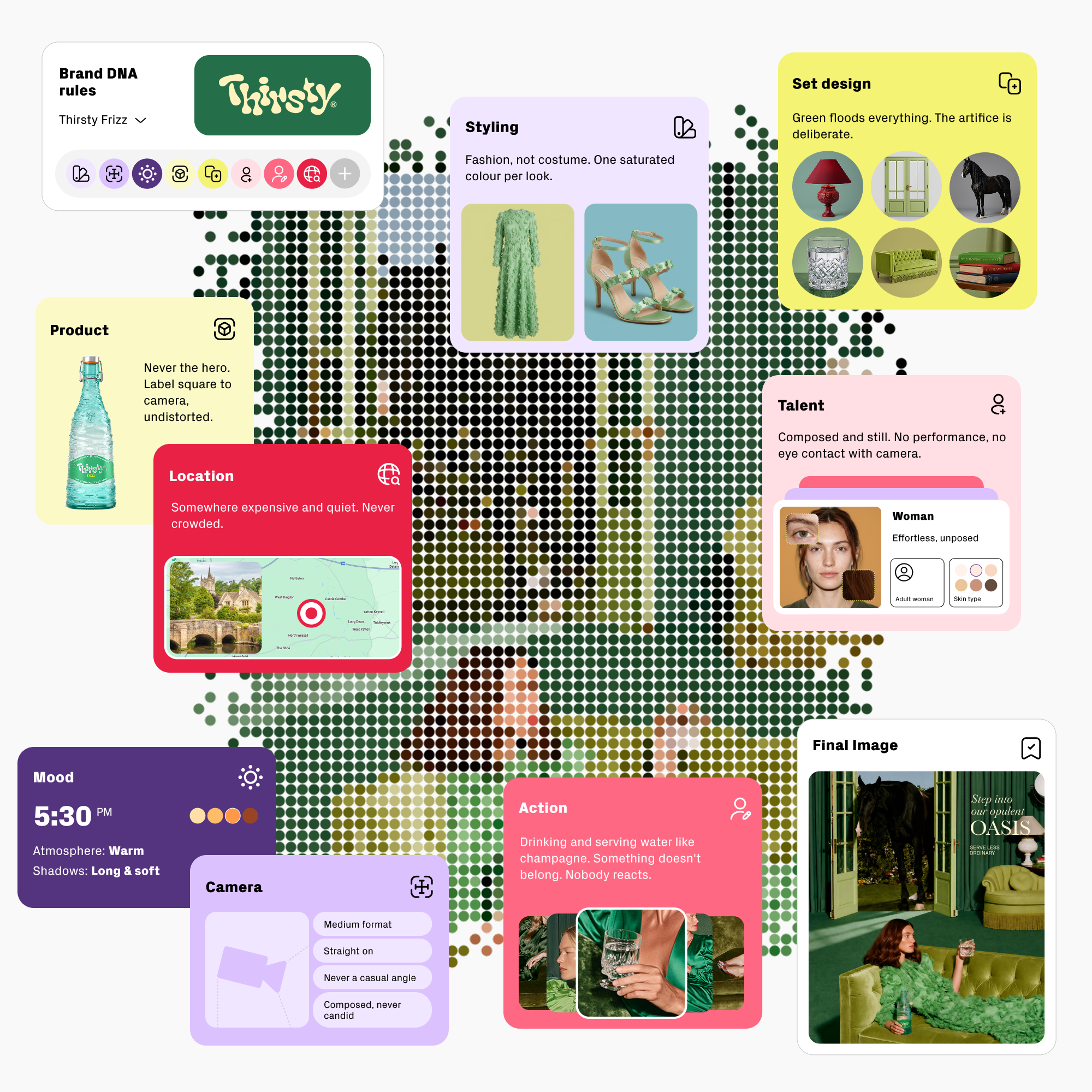
The second way is when AI is used as an executor inside a system that encodes what the brand uniquely knows. Product truth as structured data is part of it, a key part. However, another essential layer is where the brand DNA lives. But also: the constraints per market, the audience and channel rules. And most critically, the tacit knowledge no one could enumerate in a prompt: what this brand does and never does, what worked last quarter, why a specific choice is off-limits in this product category.
An orchestration layer surfaces the right rules at the right moment for the asset being generated. No human is assembling the input.
This is where the "flattening" stops. It is not because the prompt is phrased better. The rules governing the model are too many and too contextual to fit in any prompt. They live in a system that feeds them in agentically, the right rule at the right moment. That system does not try to imagine a product via AI. It will decide to render the bottle, jar, or can with its label; or the watch with its strap and faceplate; or the car or bike with its color, finish, and accessories; or the outfit or pair of shoes with its colorway. All against the rules that govern each category.
The structural fix
The structural fix is not art direction on top of manually driven AI. It is the system that surfaces what the brand uniquely knows within the required context.
The article notes the window for distinctiveness is open but closing. For visuals it closes faster. A consumer reads a paragraph before deciding it sounds like AI. They process a frame in a few hundred milliseconds.
The brands that get this, will be building content infrastructure that codifies their product truth, their brand DNA, and the working knowledge their best teams hold tacitly. The rest will keep prompting their way into the greyness that makes them indistinguishable from one another.
About Grip
As INDG’s software branch, Grip is a visual content configuration engine powered by NVIDIA Omniverse that makes it possible for large enterprises to use AI at scale. It breaks existing content down into configurable modules, allowing brands to swap out any element, including products, talent, accessories, and branding assets, with complete control and accuracy. Grip integrates with existing workflows to automate product swaps and generate endless, hero-quality content variation, without disrupting established content production processes.